
New Purchase Portal — customer experience redesign
A value-first home-buying experience with stage-aware guidance, tools before capture, and progressive profiling — replacing a rigid acquisition funnel.
The Challenge
The digital channel had to serve two jobs at once: help people understand a complex, multi-stage purchase, and feed the business a qualified pipeline. In practice, the experience had drifted toward the second job so strongly that the first was hard to find — which showed up as weak early engagement, and broker conversations that started with too little context about what people had already tried to figure out for themselves.
- Intent mismatch: many sessions were exploratory or comparative, but the UI entry point assumed “apply now” readiness — which locked visitors into a multi step form before reaching a gate that needed additional credentials before progressing or loose all the information provided, rather than also providing guidance, assistance and building confidence in next steps.
- Minimal context for downstream teams: high drop-off at the gate meant brokers and product often saw either nothing or a partial profile, with little sense of which tools, stages, or concerns had mattered before someone stalled.
- Design constraint: some visitors were ready to move straight to finance and application; others were still early in the journey — exploring, comparing products, or getting their paperwork in order. The legacy funnel did not distinguish between those modes: everyone met the same capture-first path. Lending stays regulated and broker capacity is finite, so we could not simply strip qualification — the challenge was to re-sequence help, capture, and proof so they appeared when they genuinely matched where someone was in their purchase, and still served the business.
Business Goals
Early in discovery, product and stakeholders framed what the initiative had to achieve for the business — before we pinned down specific UX mechanisms. Those were directional “north stars”, not yet a testable experience brief.
Preliminary business goals (discovery)
- Improve digital engagement and reduce early abandonment, without walking away from compliant capture where it mattered.
- Increase the quality and usefulness of opportunities reaching brokers — fewer cold hand-offs, richer context when someone did engage.
- Protect and strengthen trust and brand fit at the first digital touch, particularly for buyers who were not yet application-ready.
- Align the channel with how Australians actually buy: long timelines, different entry points, and work that continues well before a formal application.
- Balance acquisition targets with a credible help-and-preparation role so marketing, digital, and broker networks pulled in the same direction.
Those outcomes still left open how the experience should behave. Through research — interview synthesis, journey and funnel critique, and workshops with product — I translated the preliminary goals into a concrete, experience-level target state. The list below was recommended by me, stress-tested with stakeholders, and approved as the guiding set of business goals for the portal direction and later usability work.
Business goals (recommended after research, then approved)
- Deliver value before capture: calculators, checklists, guides, and stage hubs without a contact wall at the first click.
- Match a realistic purchase lifecycle (from early research through to settlement and move-in), not a compressed funnel.
- Support progressive profiling: light save (email workspace) first; richer data only when it unlocks clearer help.
- Make next steps transparent so people understand sequencing, trade-offs, and when a broker conversation is worthwhile.
- When someone is ready, give brokers a useful snapshot + richer profile context (what was explored, saved, and declared).
What Was Done
Research & framing
- Reviewed existing funnel behaviour (where people dropped off, what they were asked too early) and synthesised interview notes into a clearer problem statement: the experience was optimised for capture, not preparation.
- Ran working sessions with product and stakeholders to translate the “north star” goals into practical design principles (value before capture, stage-aware guidance, transparent next steps, progressive profiling).
- Mapped the wider purchase lifecycle into a usable set of stages, then used that map to align on scope beyond the legacy “four-stage” UI model.
Design exploration
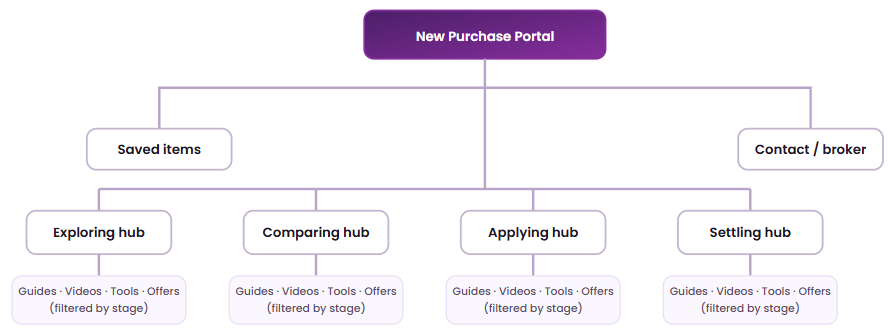
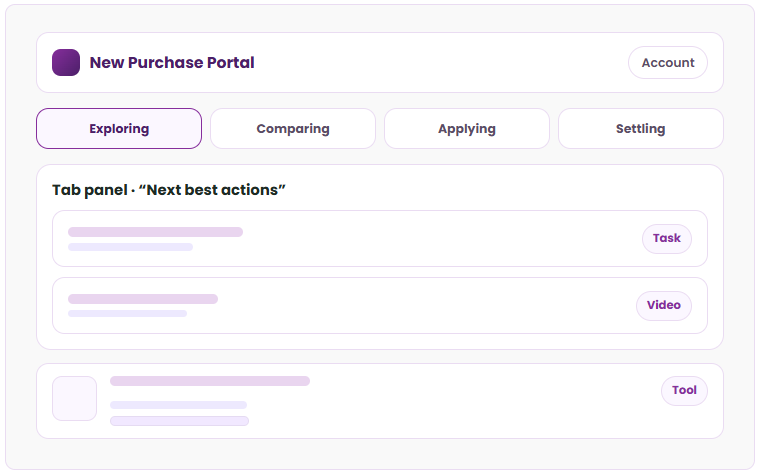
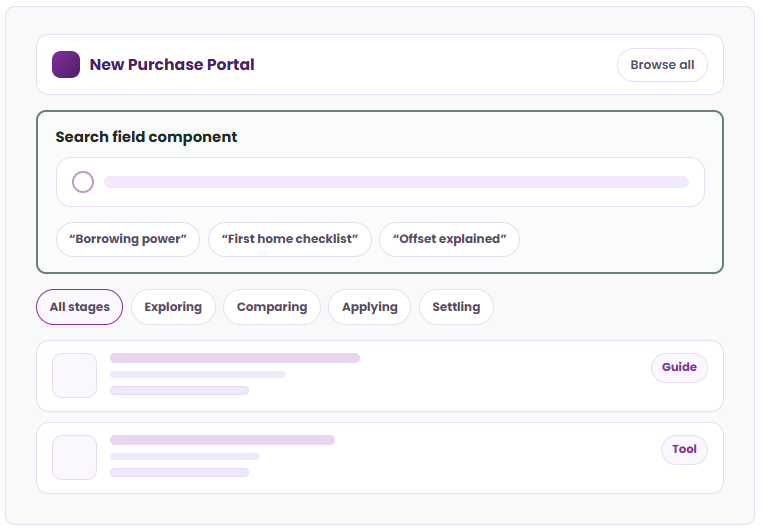
- Shaped an IA built around stage hubs, with repeatable content/tool modules (guides, checklists, calculators, offers) that could be reused across stages without duplicating work.
- Worked through key journeys and edge cases (wrong-stage entry, return visits, “ready now” vs “still exploring”) so the experience could flex without forcing everyone into the same form path.
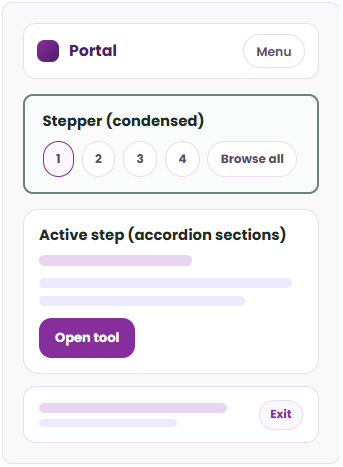
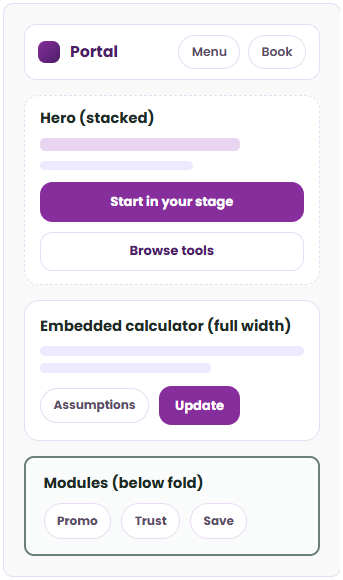
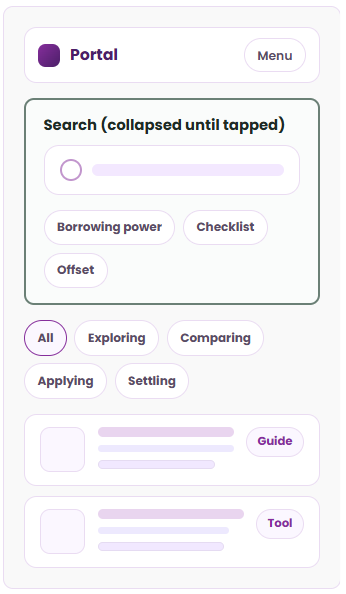
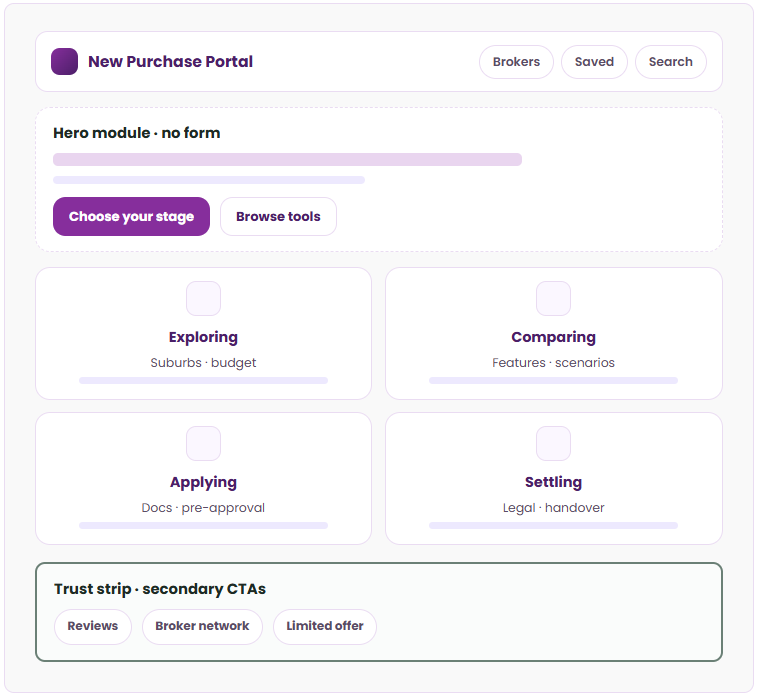
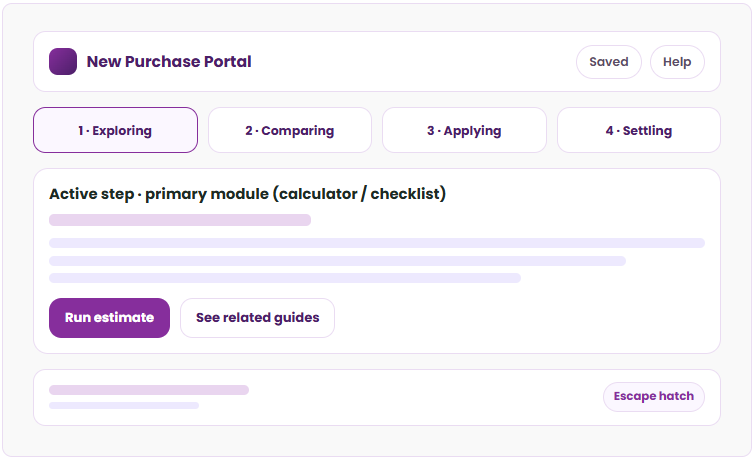
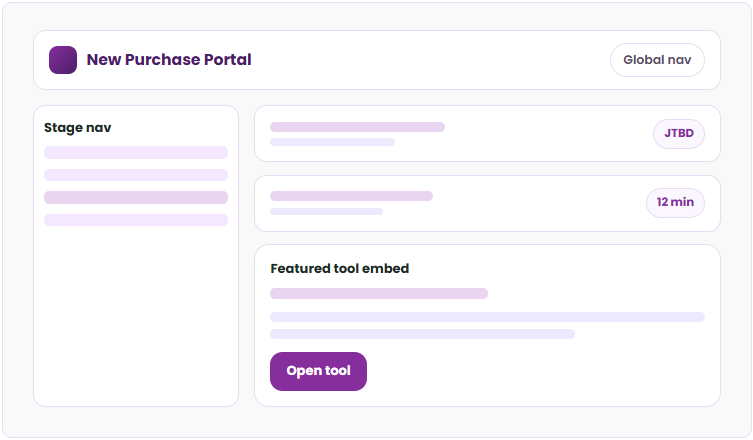
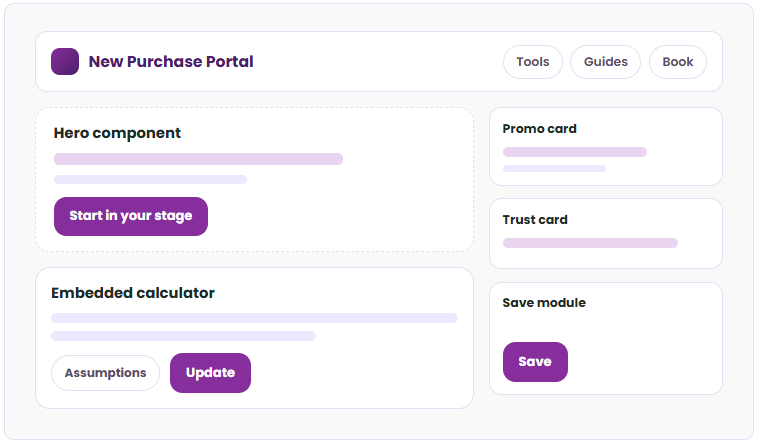
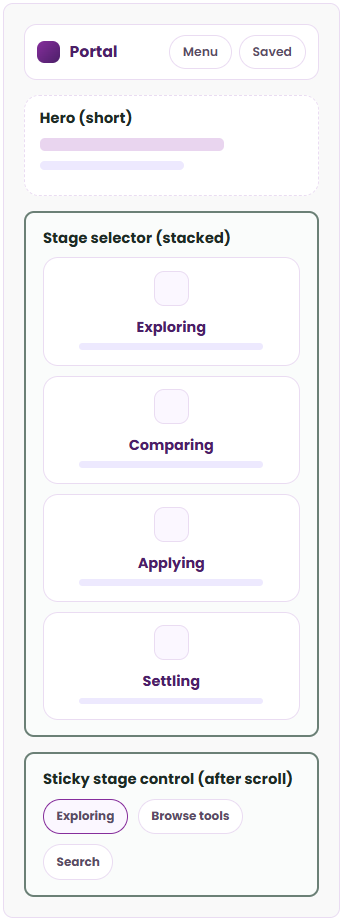
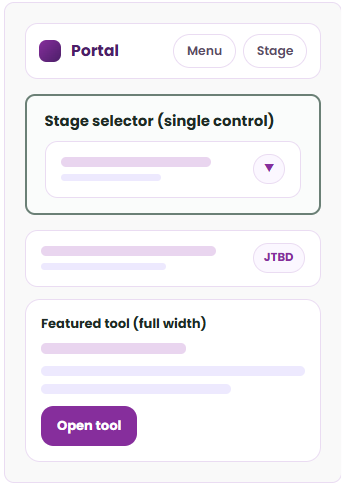
- Explored multiple low‑fidelity layouts (baseline plus options A–F), pressure-tested them with stakeholders and engineering, then converged on a desktop + mobile shell for prototyping.
Validation
- Ran two rounds of moderated usability sessions on the prototypes, focusing on stage discovery, finding a useful tool quickly, and understanding what “save” meant.
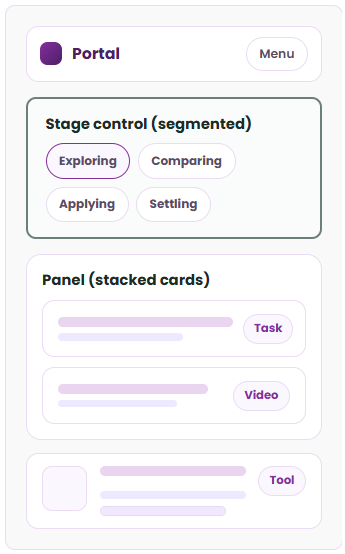
- Iterated the mobile stage controls and navigation patterns after early sessions showed people missing stage switching and struggling to recover from “wrong stage” entry.
- Captured outcomes, trade-offs, and recommendations in a clear stakeholder-ready artefact to support alignment and handoff.
Screenshots
The following mid-fi screens were used to review with stakeholders and test concepts with participants.
Desktop
Mobile
Results
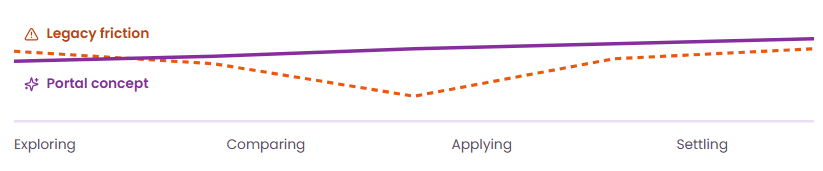
Outcomes from moderated usability sessions on prototypes.
Key Learnings
Home buying is a long, non-linear journey; experiences that behave like short acquisition funnels create mistrust when they demand sensitive answers before context. Designing for progressive disclosure — tools first, capture when intent is clear — materially improves early comprehension and task success in testing. The next step is instrumentation in a real product environment to validate which hubs and tools genuinely build broker-ready intent.